
Last verified: August 12, 2026
Review basis: Official Ideals product, pricing, security and help-center documentation; verified third-party review platforms; and published real estate customer case studies.
Ideals Virtual Data Room is a secure document-sharing and due diligence platform used for M&A, fundraising, real estate transactions, and other confidential business processes.
For real estate teams, Ideals is best suited to commercial property acquisitions and sales, portfolio due diligence, competitive bidding, real estate M&A, fundraising, and transactions involving multiple external advisors.
The platform combines eight document permission levels, dynamic watermarks, Fence View, Q&A, audit trails, document engagement reporting, automatic indexing, redaction, eSignature, and configurable data-hosting locations.
Ideals does not publish fixed dollar prices for its VDR plans. Instead, it offers Core, Premier, and Enterprise plans using a usage-based pricing model. All three plans currently support unlimited users.
For buyers comparing the wider market, see our guide to the best real estate virtual data rooms.
Ideals VDR at a glance
| Category | Ideals VDR |
|---|---|
| Best for | Commercial real estate due diligence, portfolio sales, M&A, fundraising, competitive bidding and multi-party transactions |
| Pricing | Quote-based, usage-based pricing |
| Plans | Core, Premier, Enterprise |
| Users | Unlimited on all three plans |
| Projects | One on Core and Premier; unlimited on Enterprise |
| Core storage | 0.5–2 GB |
| Premier storage | Tailored |
| Enterprise storage | Tailored |
| Document permissions | 8 levels |
| Q&A | Yes |
| AI-powered redaction | Yes |
| Dynamic watermarking | Yes |
| Fence View | Yes |
| eSignature | Yes |
| Mobile application | Yes |
| Free trial | Full-functionality trial available |
| G2 rating | 4.7/5 |
| Capterra rating | 4.8/5 |
| Founded | 2008 |
Plan specifications are based on the current official Ideals pricing and feature comparison. Ideals lists Core as a single-project plan with five administrators, unlimited users and 0.5–2 GB of storage; Premier adds unlimited administrators and tailored storage; Enterprise supports unlimited projects, administrators and users.
What is Ideals Virtual Data Room?
Ideals Virtual Data Room is a cloud-based VDR designed to store, organize, review and exchange confidential documents during business transactions.
Ideals Solutions Group was founded in 2008. Its current Trust Center states that the company has served more than 2 million users across 175,000 organizations.
A VDR differs from ordinary cloud storage because administrators can control not only which files a participant can access but also what that participant can do with those files.
In Ideals, transaction administrators can use features including:
- Eight document permission levels
- User groups and roles
- Two-step verification
- Dynamic watermarks
- Fence View
- IP and domain restrictions
- Access schedules and expiration
- Document versioning
- Automatic indexing
- Full-text search and OCR
- Q&A workflows
- Notes and document comments
- Detailed audit trails
- Document engagement reporting
- Redaction
- eSignature
- Project archives
These controls make the platform more suitable for confidential due diligence than conventional file-sharing services.
Why Ideals is relevant to real estate
Real estate transactions combine large document volumes with multiple professional stakeholders.
A commercial property acquisition can involve buyers, sellers, brokers, attorneys, lenders, accountants, engineers, environmental consultants, property managers and investment committees.
Ideals itself identifies real estate due diligence, asset management, investment management, portfolio management, bankruptcy and restructuring among the real estate applications for virtual data rooms.
The platform can therefore be used to organize documents such as:
- Rent rolls
- Lease agreements and amendments
- Historical operating statements
- T12 financials
- Title reports
- Surveys
- Environmental reports
- Property condition assessments
- Zoning documents
- Permits
- Insurance policies
- Tax records
- Loan documents
- Purchase and sale agreements
- Corporate records
- Development documents
Our real estate due diligence guide explains how these documents fit into the broader review process.
Ideals features for real estate due diligence
Ideals currently provides eight document permission levels. This gives administrators more control than a simple view/download setting.
Depending on configuration, participants can be assigned different levels of access to individual documents or folders. This is useful when a transaction involves several groups with different responsibilities.
For example, a seller can give:
- Buyers access to general diligence materials
- Lenders access to financial and financing folders
- Environmental consultants access to environmental reports
- Lawyers access to leases, title and corporate records
- Internal administrators broader project access
Permissions can also be adjusted as a transaction progresses.
For competitive real estate sales, this helps sellers expose information gradually rather than giving every bidder unrestricted access from the beginning.
Ideals includes Fence View, a document-protection feature designed to obscure parts of a document while it is being viewed and reduce the risk of unauthorized screenshots.
Fence View is particularly useful for sensitive information such as:
- Tenant data
- Rent rolls
- Investor lists
- Financial models
- Personal information
- Acquisition strategies
It supplements rather than replaces standard access permissions.
Ideals supports customizable dynamic watermarks.
Watermarks can associate viewed or distributed documents with user information, helping discourage unauthorized redistribution of confidential materials.
For property transactions, administrators may use watermarking for offering documents, leases, financial information, appraisals and other sensitive files.
Ideals automatically indexes files and folders within the VDR.
Transaction teams can create structured indexes such as:
2.0 Financial Information
3.0 Rent Roll and Leases
4.0 Title and Legal
5.0 Environmental
6.0 Engineering
7.0 Tax and Insurance
8.0 Financing
Automatic indexing is useful when a data room contains hundreds or thousands of documents and several outside teams need to reference the same information.
The platform also supports document versioning, folder-structure imports, bulk renaming, OCR and full-text search.
Ideals now includes a dedicated due diligence checklist within its current product offering.
This allows transaction teams to track information requests and diligence progress alongside the underlying documents.
For a real estate acquisition, a checklist can help organize workstreams covering financial, legal, environmental, operational and physical-property review.
This is particularly useful for acquisitions involving several assets or several specialist advisors.
Ideals provides a built-in Q&A system so questions can be managed inside the transaction environment rather than through disconnected email chains.
The platform supports Q&A threads and configurable workflows, including approval functionality.
A seller running a competitive real estate process can use Q&A to manage questions relating to:
- Lease provisions
- Historical expenses
- Tenant renewals
- Capital expenditure
- Environmental conditions
- Title matters
- Financing
- Property operations
Centralizing these questions creates a clearer transaction record and reduces fragmented communication.
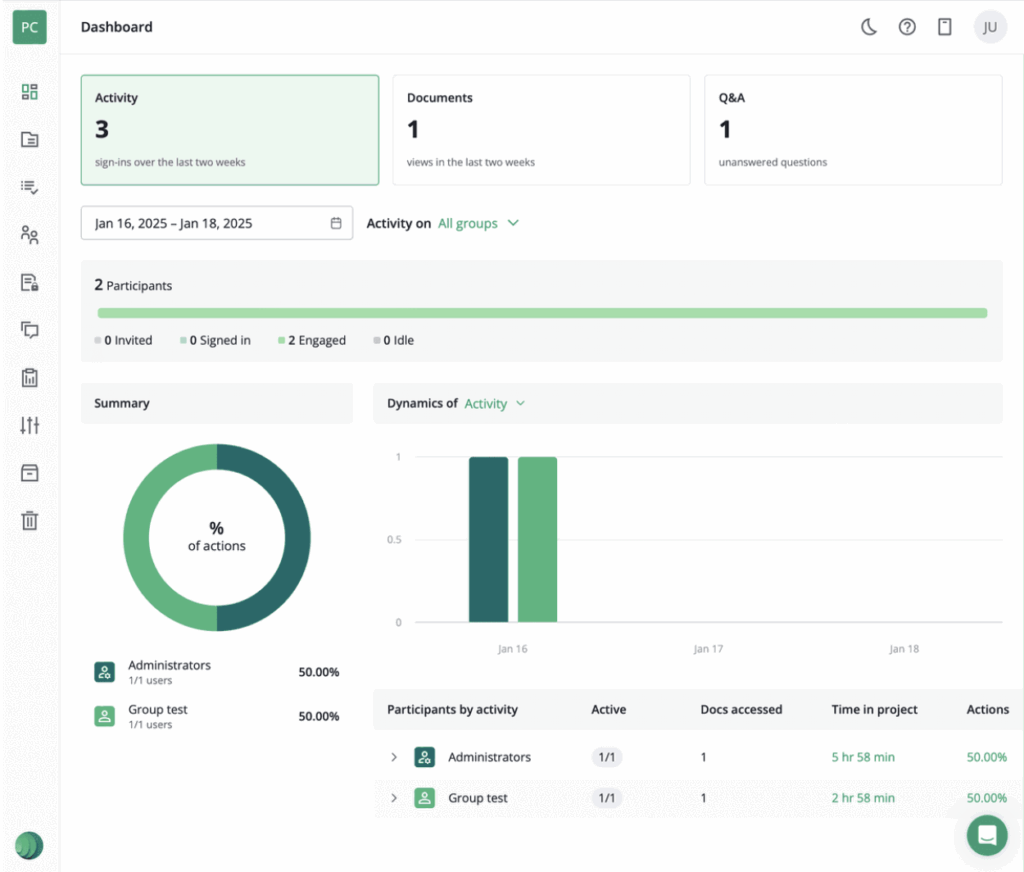
Ideals provides reporting tools that can show project activity and participant engagement.
Current functionality includes:
- Project-progress dashboards
- Participant engagement tracking
- Document viewing-time analysis
- Granular audit trails
- Scheduled reports
- Report alerts
These reports can help a deal team understand which materials participants are reviewing.
Engagement data should not be treated as proof of bidder intent, but it can provide useful context during a competitive process.
AI-powered redaction is included in Ideals’ current Core plan and therefore does not require an Enterprise subscription.
Redaction can reduce manual work when transaction documents contain sensitive information that should not be visible to every participant.
Typical real estate examples include:
- Tenant personal information
- Bank-account details
- Employee information
- Confidential pricing
- Signatures
- Personally identifiable information
Users should still review automated redactions before releasing documents because responsibility for the final disclosure remains with the transaction team.
Ideals is adding AI functionality beyond redaction.
The current Premier plan includes AI chat with document, along with document translation and other advanced transaction capabilities. Enterprise is designed for organizations handling a larger pipeline of simultaneous projects.
For real estate firms, document-level AI may be most relevant to large portfolio acquisitions where teams need to navigate extensive lease, financial and legal documentation.
The value of AI features should be evaluated separately from the VDR’s core security and permission controls.
Electronic signature is included in the current product offering.
This allows teams to execute supported documents without necessarily moving every signing workflow to an unrelated platform.
Whether a particular document should be signed electronically through the VDR depends on the transaction, jurisdiction and legal requirements.
Ideals virtual data room pricing and plans
Ideals offers clear, adaptable pricing plans suitable for both small firms and big corporations that manage complex financial transactions. The Ideals pricing plans are designed for security, efficiency, and cost-effectiveness, with no hidden fees.
| Plan / Features | Core | Premier | Enterprise |
|---|---|---|---|
| Projects | 1 | 1 (Premier) or Unlimited (Business) | Unlimited |
| Admins | 5 | Unlimited | Unlimited |
| Users | Unlimited | Unlimited | Unlimited |
| Storage | 0.5–2 GB / 10 GB | Up to 250 GB | 1 TB–10 TB |
| Best for | Small / medium deals, affordable | Larger deals, advanced security | Enterprise, multi-project, scalable |
| Check price | Check price | Check price |
Key features across all plans
- Unlimited users
- Two-factor authentication
- Impeccable customer service
- Dynamic watermarks
- SOC/ISO-certified data centers
- 24/7 support and onboarding help
- Advanced security and audit trails
Ideals does not currently publish standard dollar prices for these plans. Buyers request a quote based on their project requirements.
Capterra categorizes the pricing model as usage-based rather than per-page and confirms that Ideals offers a free trial without requiring a credit card.
For context on how this model compares with flat-rate, per-user and per-page providers, see our virtual data room pricing comparison.
Is Ideals pricing transparent?
Ideals describes its commercial model as usage-based pricing with no per-page charges.
That is more transparent than legacy VDR models where charges can rise with each page uploaded, but it does not mean that fixed public prices are available.
The actual price still requires a quote. Therefore, the most accurate description is:
Ideals provides transparent plan structures and usage-based pricing, but the final dollar price is quote-based.
This distinction is important when comparing VDR vendors.
Ideals free trial
Ideals currently offers a full-functionality trial with no initial payment required.
The trial environment can be converted into a paid project without requiring users to upload their documents again.
This gives real estate teams an opportunity to test:
- Folder structure
- Permissions
- Redaction
- Q&A
- User invitations
- Watermarking
- Document reports
A trial is especially useful before a major sale process because permission errors are easier to correct before external bidders enter the room.
Ideals security and compliance
Security is one of the main reasons businesses use a VDR instead of conventional cloud storage.
The Ideals Trust Center currently lists security and compliance frameworks including:
- SOC 2 Type II
- ISO 27001
- ISO 27017
- ISO 27701
- GDPR
- CCPA
- HIPAA
- CSA STAR Level 1
- DORA
- Data Privacy Framework
The Trust Center also provides access to security documentation and reports, with some materials requiring an NDA.
Ideals’ published technical specifications also state that the platform uses 256-bit AES encryption for data at rest and SSL/TLS-protected data transfer.
Other access-security controls include:
- Two-step verification
- IP restrictions
- Domain restrictions
- User groups
- Eight permission levels
- Access schedules
- Automatic access expiration
- Custom password policies
- Session timeout settings
- Email verification
- Dynamic watermarking
- Fence View
Organizations with specific regulatory requirements should verify the exact certification scope, data-processing terms and contractual requirements directly with Ideals rather than relying only on a marketing page.
Data hosting and residency
Ideals allows administrators to select where a project is hosted.
Its current storage-location documentation lists 11 locations:
Europe
- London
- Paris
- Frankfurt
- Madrid
Asia
- Beijing
- Mumbai
- Singapore
- Tokyo
Oceania
- Sydney
North America
- Columbus, Ohio
South America
- São Paulo
The ability to choose a project location can matter for organizations with data-residency, regulatory or internal governance requirements.
Ideals for commercial real estate acquisitions
A commercial property buyer can use Ideals to centralize due diligence while separating specialist workstreams.
A typical workflow could include:
- Uploading seller documents into a structured index.
- Creating groups for legal, financial, tax and technical advisors.
- Assigning permissions to relevant folders.
- Redacting information that should not be broadly disclosed.
- Tracking missing information through the diligence checklist.
- Managing questions through Q&A.
- Reviewing activity through audit reports.
- Archiving the project after completion.
This becomes especially valuable when multiple assets or legal entities are involved.
Ideals for portfolio sales and competitive bidding
Competitive dispositions require tighter access management than straightforward document sharing.
A seller may need to invite several potential buyers while preventing one bidder from seeing information intended for another.
Granular groups and document permissions allow administrators to segment access during different phases of the transaction.
Approved buyers receive teaser-level diligence.
Shortlisted bidders receive leases, financial statements and technical reports.
The preferred bidder receives additional sensitive legal and financing information.
This structure gives sellers greater control over disclosure while maintaining one central document repository.
Ideals for real estate M&A
When a buyer acquires a real estate operating company, management platform or REIT rather than an individual property, due diligence expands beyond property documents.
Review may include:
- Corporate records
- Employee information
- Material contracts
- Debt
- Litigation
- Tax matters
- Technology systems
- Management agreements
- Property-level diligence
A VDR with permission groups, Q&A, audit trails and multi-project capability can help organize these larger processes.
Our real estate M&A guide explains how corporate and portfolio transactions differ from conventional property acquisitions.
Evidence of real estate use
Ideals has published several customer cases involving real estate organizations.
Cambridge RE Partners
A vendor-published case study about Cambridge RE Partners describes a Singapore-based investment manager focused largely on real estate and energy infrastructure.
According to the case study, the firm selected Ideals after comparing several VDRs and used the platform for real estate fundraising and acquisition processes.
DHV Plus
Another Ideals customer case study covers Deutsche Hausverwaltung Plus, a German property-management group using an acquisition-led growth strategy.
The company reports using Ideals for legal and financial due diligence, with requirements including separate rooms for projects, multiple permission levels, monitoring and built-in Q&A.
These are vendor-published case studies rather than independent product tests, so they are most useful as evidence of real-world use cases rather than proof of comparative superiority.
Ideals reviews
Independent software-review platforms show strong overall user ratings.
G2 currently rates Ideals Virtual Data Room 4.7/5. Recent reviews commonly discuss document security, permissions, ease of setup, auditability and customer support; some reviewers mention pricing or mobile experience as potential limitations.
Capterra rates Ideals 4.8/5 based on 319 reviews, with the listing last updated June 3, 2026. Capterra separately rates ease of use and customer service at 4.7/5.
Review scores change as additional reviews are published, so ratings should always be shown with a verification date.
Ideals pros and cons
| Pros | Cons |
|---|---|
|
|
Who should choose Ideals?
Ideals is a strong candidate for:
- Commercial real estate investment firms
- M&A teams
- REITs
- Real estate private equity firms
- Brokerage and advisory teams
- Developers
- Asset managers
- Legal teams
- Institutional investors
- Lenders
- Organizations running competitive property sales
It is particularly relevant when a transaction requires multiple permission groups, confidential information, structured diligence, Q&A and detailed activity records.
When should you consider another VDR?
Another provider may be more appropriate when:
- You require a low-cost public monthly price.
- Your project contains only a few documents.
- You need unlimited storage at the lowest plan level.
- Your organization already has an enterprise deal platform.
- A specialized workflow offered by another VDR is essential.
The virtual data room comparison explains how Ideals compares with other providers used for secure transactions.
Final verdict
Ideals is a transaction-focused virtual data room with a strong combination of granular permissions, document security, due diligence workflows and reporting.
For real estate, its best fit is not routine property file storage. It is transactions where confidential documents must be shared with buyers, lenders, attorneys, consultants or investors under controlled access.
The most relevant strengths are its eight permission levels, Fence View, dynamic watermarks, Q&A, due diligence checklist, redaction, engagement reporting and selectable data-hosting locations.
The main limitation is pricing transparency at the dollar level: Ideals clearly publishes the structure of Core, Premier and Enterprise plans, but users still need a quote to determine the actual project cost.
For commercial real estate due diligence, portfolio transactions, fundraising and real estate M&A, Ideals is therefore one of the more complete VDR options to evaluate.